Showing posts with label Palette Dyeing. Show all posts

Friday, March 12, 2010

Topaz Award, Merit program, McGown Pattern


One of the requirements of the Topaz award for the Merit program is to hook an early McGown pattern. To learn more about McGown patterns, I found (on the internet) an old copy of Pearl McGown's book "YOU . . . can HOOK RUGS". It was reprinted in 1953 and smelled like it had been in someone's basement since 1954, but I read it anyway to learn more about the woman and her patterns.


Pearl was definitely my kind of woman! In 1930 she hooked her first rug and took off running from there. Although she loved hooking, her interest was more into creating patterns (she had well over 1,000) and her business had gotten so big that she enlisted help from her son, two sisters, and her father-in-law. She bought the larger house across the street (she named it the 'Rose Cottage') just so that she could hold her patterns and swatches, and have a place for hookers to get together and share their rugs and discuss the aspects of technique, color, and teaching others. She and her helpers would hand draw on burlap the patterns that she designed.

Pearl McGown was very much into an artistic effect when hooking a rug. She realized that the only way to achieve this effect was to use a graduation of hues to hook flowers, leaves, or to accentuate a scroll, all with using fine cuts of wool. Her book is a wealth of information! She covers all aspects of rug hooking, my most favorite is the drawings which illustrate where to put each value in different leaves and flowers to help you 'see' that particular item in a realistic way. It is such a shame that the majority of the beautiful rugs in the book were not in color. However, the ones that are were beautiful.

For my project, I chose one of her chair pads that I squared off for a pillow. Recently, our rug hooking group offered a workshop with Nola Heidbreder, a certified McGown teacher, so she helped me with my pillow. Nola is a fabulous teacher! She is so into the 'fun' aspects of hooking and embellishing. So I wouldn't miss out on the fun, I would hook on my pillow for a few minutes then go and do some of her fun things she taught us in hooking. If you EVER get the chance to have a class with Nola, I HIGHLY recommend her. Anyway, I got the jest of hooking the McGown way. There is a lot to learn and my attempt is puny at best in comparrison to rugs in Pearl's book. I used a #4 cut with some of the Palette Dyed swatches I dyed from April DeConick's virtual class "Palette Dyeing' on RUG HOOKING DAILY.
I may also get credit in the Garnet Award for using a fine cut. I'll check on that.

Wednesday, January 13, 2010

Finished Color Rug!


Just finished the binding last night on the Color Rug for the Merit Program. This rug has 6 of the projects required for the Peridot Award, each project is either 10x10 inches or 5x20 inches (total area each project 100 square inches for a sampler rug). I chose the following projects to hook in my rug: a color wheel, all primary colors, complimentary colors, tertiary colors, cool/warm colors, and an obvious balance color plan.
To begin, I measured off blocks on my linen and then drew a design for each category as I finished the previous one. All colors co-ordinated in some form or fashion because I dyed the wool with one color palette using April DeConick's "Palette Dyeing" method. It is amazing how the colors flow and blend together using this dyeing method. I was worried about how it would look to hook primary colors next to the other projects, but it doesn't seem to matter since all the colors are from the same family of dyes.
On the border are words that I learned about color, and when possible I hooked with the appropriate wool to demonstrate that word.

Value,
Tint,
Shade,
and Tone
are examples. The words for the 6 projects that I chose to complete the Peridot Award are next to the project. I also had room for my

secondary colors
and my neutrals.
Because I chose to do lettering in the border and binding my rug by whipping with yarn, I will get credit for two projects in the Ruby Award. And, by dyeing all the wool in this project using chemical dyes, I get credit for one project in the Amethyst Award.
I will now submit my rug and descriptions to the Merit program for review.

Saturday, January 9, 2010

Neutrals, Tones, and Shades (Palette Dyeing)


In the past week I have been dyeing more wool to finish up my Palette Dyeing. I am learning Neutrals (equal amounts of complimentary colors), Tones (color plus grey), and Shades (color plus black). It is so exciting to see the colors that are created using the color palette that I chose. This is a picture of my Neutrals; two values of red and green, two of blue and orange, and two of yellow and violet. Each is so unique.

Next are my Tones. I used a yellow-green in value #2 with 1/16, 1/8, 1/4, 1/2, and 1 tsp. of my grey dye mixture (grey dye used was Pro Chem Mouse Grey). The top swatch is the original color.

Here is what it looks like on my Color Rug.

Last are my swatches of Shade. I used value #2 of red-orange with 1/16, 1/8, 1/4, 1/2, and 1 tsp. of my black dye mixture (Pro Chem Black). The first swatch is my original color.

Here is what it looks like in my rug.

I really thought that dyeing Neutrals, Tones, and Shades would be boring but I was quite surprised at the results. I really like the Shades and can see where it would add a lot of depth to hooking a rug.

Sunday, January 3, 2010

Continuing on with the Color Rug . . .


I am continuing to hook on my 'rug of color' for the Peridot Award. The border is almost finished, I do want to make some changes, however. I worked my initials in the neutral colors from my "Palette Dying", but it looks out of place so I will re-hook them using a color with the blue-green border background. That will be more consistant. (If you want a laugh, look closely at my initials. I hooked them upside down and got the 'J' backwards. Think before you hook!) Also, I haven't dyed the wools for the "TONE" and the "SHADE", so the lettering will be pulled out and re-hooked using wools dyed for those words.
It took me forever to decide what to hook for the 'balanced' part of the rug. It is so darn narrow nothing seemed to work. My husband suggested hooking a neck tie . . . it is long, I could make it colorful . . . but it didn't go with the rest of the rug. I'm going with a kind of patch work quilt thing and have a "Georgia Peach' in the center squares.
I'm sure hoping to have this thing completed in the next few weeks!

Tuesday, October 27, 2009

Re-visiting Complementary Colors


When I hooked the Complimentary colors, I was wanting a better transition on my background from values 5 to 4 and 4 to 3. I decided to dye two more values of the blue-violet calling them values 4 1/2 and 3 1/2 to see if it would make a difference in the transitions. To figure how much formula of dye to use, I divided the difference in the measurements between the two values by half (the difference of value 5 and 4 was 1 tsp. of formula, half of that = 1/2 tsp.). My total amount of formula for value 4 1/2 will now be . . .
1 1/2 (value 4 amount) + 1/2 (the extra amount)= 2 tsp. Complicated unless you have done Palette Dyeing, but I'm pretty sure that I think I know what I think I'm doing. Anyway, to compound the confusion and just because I'm cheap, I wanted only to dye half of the amount of wool normally used for one value. So, now for my 4 1/2 value I will be using 1/2 the wool and 1/2 of the 2 tsp. = just 1 tsp. of blue-violet dye formula. Was it worth the trouble? I don't know, you tell me . . .


It was a fun experiment. Maybe it made a slight difference, but I would always wonder if I hadn't tried it out. And, it gave me something else to blog about.

Sunday, October 25, 2009

Warm and Cool Colors (Peridot Award) Merit Program


On the Peridot Award, one of the choices is to hook a mat or 10x10 inch square in a rug of warm or cool colors. I asked permission to combine the warm and cool in one area of my rug as I thought it would be interesting to see the contrast between the two. I think it was very effective in my hooked butterfly. It was a challenge to choose the wool from my dyed palette of colors, but I came up with a combination that I liked. This is a picture of how the rug is progressing.


It will be a rug of the six chosen projects of the Peridot Award. As a plus, I will be using lettering in my border and finishing the rug which will count as two projects from the Ruby Award. Dying all the wool for this rug counts as one project for the Amethyst Award.

When I need more of a certain color for the rug from the color palette, I can determine which value I want and I am able to dye just that one value in the amount of wool that I need. Such will be the case when I hook the border of my rug. I will need about 3/4 of a yard of Blue-Green value #7. April DeConick has given a chart for us to determine how much of our formula to dye 1/2 and 1 yard increments of the values we need in her Palette Dyeing class.

For the next project, I will be trying some prodding.

Sunday, October 18, 2009

Complimentary Colors (Peridot Award) Merit Program


This is my example that I hooked of Complimentary Colors (colors opposite the color wheel) for the Peridot Award. I have used all 8 values of Yellow-Orange for the pumpkin and leaves and values 7 to 3 of Blue-Violet for the background. I am wanting a smoother transition on the background between values 5 to 4 and values 4 to 3, so I think I will dye a strip of wool in between those particular values and hook only one row using those new values (let's call them value 4 1/2 and 3 1/2). It will be interesting to see how much smother the transition will be.
Click on any photo to see pictures close-up.

Friday, October 16, 2009

Merit Program (Peridot Award) Primary Colors


My second project for the Peridot Award is to hook a 10x10 inch area using only primary colors. I have drawn three stars along with some stripes and have hooked red and blue stripes with yellow stars. I began with the darkest values and progressed to the lighter values on the stripes. With the stars, I used the 4 darkest values for the first star, the 4 middle values for the middle, and the 4 lightest for the last. So, I have hooked an area using only primary colors but using most or all of the values that I have dyed with my formulas.

I used ProChem dyes for my primary formulas.

My primary red formula is:
1 tsp. #307 Chinese Red
1/4 tsp. #304 Cape Cod Cranberry
1/16 tsp. #233 Bright Orange


Primary Blue:
1/2 + 1/16 tsp. #440 Blue
1/2 tsp. #495 Teal


Primary Yellow:
1 tsp. #119 Sun Yellow
1/2 tsp. #120 Golden Pear
1/32 tsp. #233 Bright Orange


All other colors in the color wheel were dyed from mixing these three formulas.

Tuesday, October 13, 2009

The Merit Program


I have been learning the Palette Dyeing process from April Deconick (Red Jack Rugs) on Rug Hooking Daily. I have now dyed eight values each of all 12 colors in the color wheel. So, having done that, I have decided to work on the the Peridot award for the Merit program. To do this I have chosen six of the eight projects and will be hooking them into one rug instead of doing individual mats. My first project was to hook the color wheel using the palette of colors. I have re-drawn my color wheel several times making a mess on the canvas before deciding to hook just plain 'ole squares. Not real creative on my part, but it got the job done. I wanted to show how subtle the color changes were from one color to the next, so I placed them next to each other without a dividing line or space. Above is my color wheel, below is my palette of colors . . . six dyed yards of values.

Tuesday, September 22, 2009

Just having fun . . .


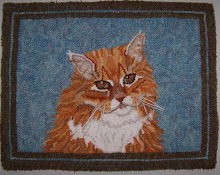
Due to all the heavy rains and flooding that Atlanta has been experiencing, I haven't been able to pick up my white wool needed to do palette dyeing from my rug hooking group. I only had 12 6x16 strips of creme wool and my primary color dyes re-figured for the umpteenth time, AND I was so very anxious to see what the secondary and tertiary colors would look like. So I spent the morning figuring out how much of the mixed dye from the primary colors I chose would it take to mix one value of each of the 12 colors. I'm certainly not a mathematician, but somehow I figured it out. It is amazing how the dyes mixed to make all the colors from my three primary dyes. This is value 4 of the 8 values. Also, this is Max the barn cat . . . who is no longer a barn cat, ever since he got kicked by a horse and broke his hip years ago. Max has decided he likes 'our' barn better than his.

Friday, September 18, 2009

Palette Dyeing

I am having so much fun doing the Palette Dyeing, I just wish I had more time in the day. I figure it takes about 2 1/2 to 3 hours start to finish (dragging out all the dye paraphernalia, dyeing the wool, and putting it all away again) to dye one set. If I didn't have to cook I would try to do two sets. I am working on finding my favorite blue, red, and yellow so I can start my color wheel. Here is a yellow I tried . . . I'm not using it because it is too brown for me, but it made a beautiful palette. It would be great for Sunflowers!

Wednesday, September 9, 2009

Palette Dyeing with April DeConick

On Rug Hooking Daily, I am taking a virtual rug camp on April DeConick's 'Palette Dyeing' technique. It is an intensive study on color and dyeing colors in 8 values. It is so fabulous . . . I am learning volumes and I've just begun.
Here is my first attempt. It is very mottled, but I was so thrilled at my sample.

I tried my hand at mixing my own formulas with the Pro-Chem dyes that I had on hand. Each set looked like brown to me. I had red brown, yellow brown, green brown, and a brown brown. However, look at what my red brown and green brown dyes produced . . .


In upcoming weeks we will be dyeing the color wheel. I'm looking forward to that!